Theoretical basis · DeYoung, 2015
Cybernetic Big Five Theory
Explains the CB5T framework, rather than reporting a study of CodeProfile.
Read the research source (opens a new tab)Personality · Anvesana Research Institute
Maps personality through 5 Big Five domains, 10 aspects, and 20 facets for a more detailed view of individual tendencies.
Specifications follow the developer's 2026 manuals. Appropriate norms, version, and use are discussed before delivery.
Sample with simulated data
This Codetrait Profile sample report uses simulated data, not real participant results.
A high score indicates a more pronounced tendency, not automatically a better one. This profile is neither a diagnosis nor a measure of actual competence.
Reports and sample questions are shown in Indonesian, the assessment language.
Loading page...
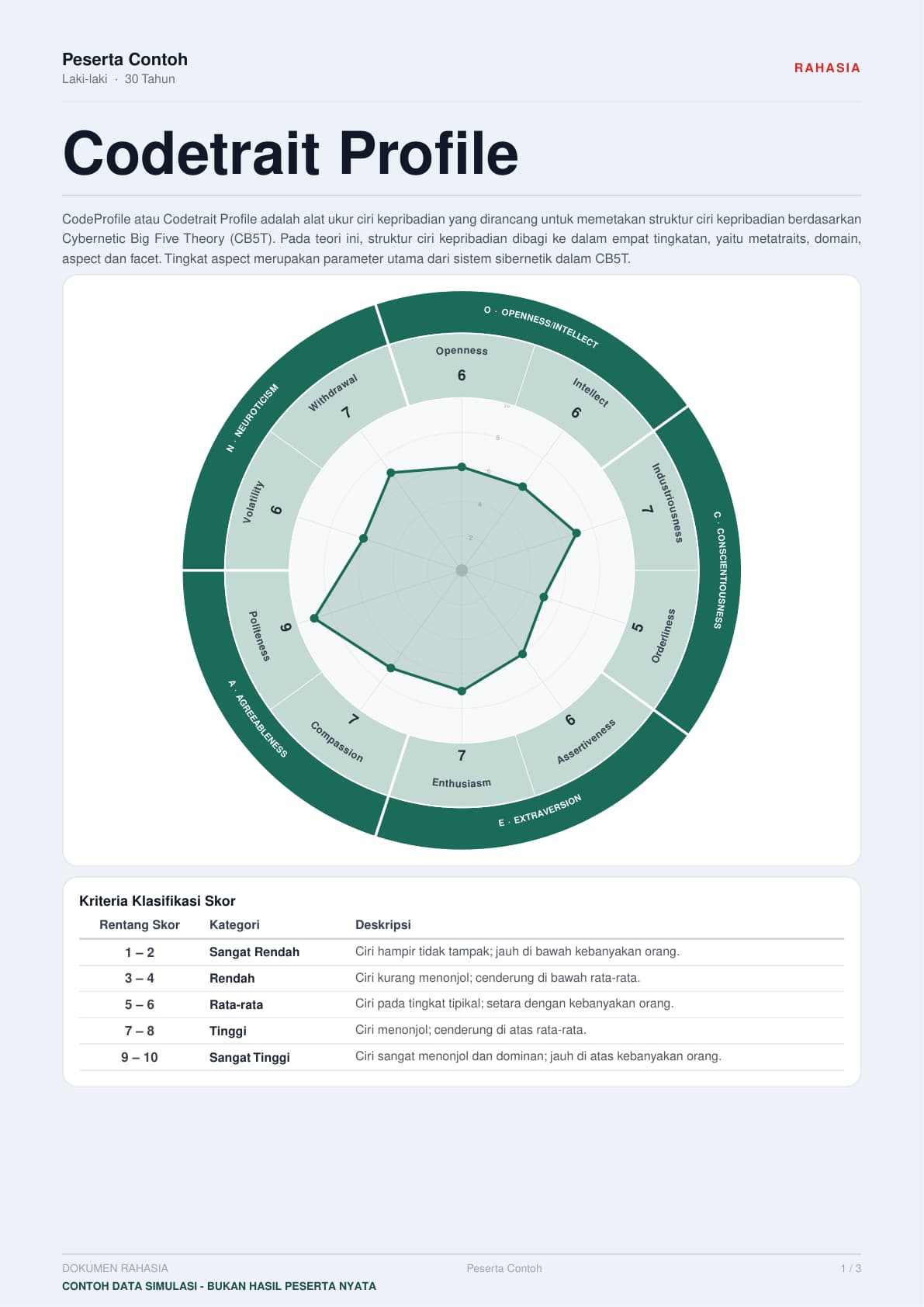
People pursue goals, build relationships, and respond to challenges differently. CodeProfile examines these patterns through 5 Big Five domains, 10 aspects, and 20 facets. Facets add detail that can be missed when looking only at broad domain scores.
Cybernetic Big Five Theory (CB5T)
5 domains → 10 aspects → 20 facets. Each domain contains two aspects, with two facets within each aspect.
CodeProfile is a nonclinical inventory. High or low scores are not automatically good or bad, and must not be the sole basis for hiring decisions. It is distinct from CodeCore, the shorter version with 79 items and 10 facets.
These introductory examples use practice-guide material, not an operational item bank. Some diagrams and choices are adapted. Examples are shown in Indonesian, the language used in the assessments. No assessment scores are produced, and your choices are not sent or stored as test results.
For each CodeProfile item, participants choose the statement A–E that best describes them (five-point Expanded Likert).
Practice example
Contoh format respons Codetrait
The CodeProfile manual reports testing with 497 participants: 72% male, 89% bachelor's graduates, and 99% living in East Java. Consider this composition before generalizing to other groups. The CB5T paper below explains the theory; it does not validate CodeProfile specifically.
Distinguish instrument evidence, response-design research, and theoretical foundations before using results for decisions.
Theoretical basis · DeYoung, 2015
Explains the CB5T framework, rather than reporting a study of CodeProfile.
Read the research source (opens a new tab)Summary sources: Technical Manual Codetrait Profile (2026), hlm. 2-9, 11-15
Reviewed 27 October 2026
Scalify clients can request the complete technical manual. Request the technical manual (opens a new tab)
Developed by

Scalify helps prepare participant access, delivery, scoring, and outputs within an agreed scope. Instrument selection and interpretation remain subject to professional competence and assessment requirements.