01
Participants and schedules are scattered
Student lists, class groups, tokens, schedules, and instructions live in separate files, making mix-ups more likely.
Run interest and aptitude tests, student mapping, selection, exams, or institution-owned tools in one workflow. Your institution defines the purpose and follow-up; Scalify supports participant management, delivery, monitoring, scoring, and result preparation.
Assessment can add context to student needs and development. Its value is often delayed, however, when participant data, delivery, and results are scattered.
Student lists, class groups, tokens, schedules, and instructions live in separate files, making mix-ups more likely.
The same workflow is rebuilt for each class or cohort, taking time away from school teams and student support.
Students, psychologists, counselors, and school leaders need different levels of detail and different result formats.
Map the purpose, instruments, readers, and delivery flow upfront so future batches are more consistent and remain reviewable.
Clarify whether the need is mapping, selection, evaluation, or testing and who will read the results.
Check the construct, age, norms, usage rights, and professional authority against the intended purpose.
Manage student lists, groups, schedules, tokens, invitations, and guidance in one flow.
Review participant progress and session notes to help the team oversee delivery.
Prepare results for the right readers, then use them alongside other context when supporting students.
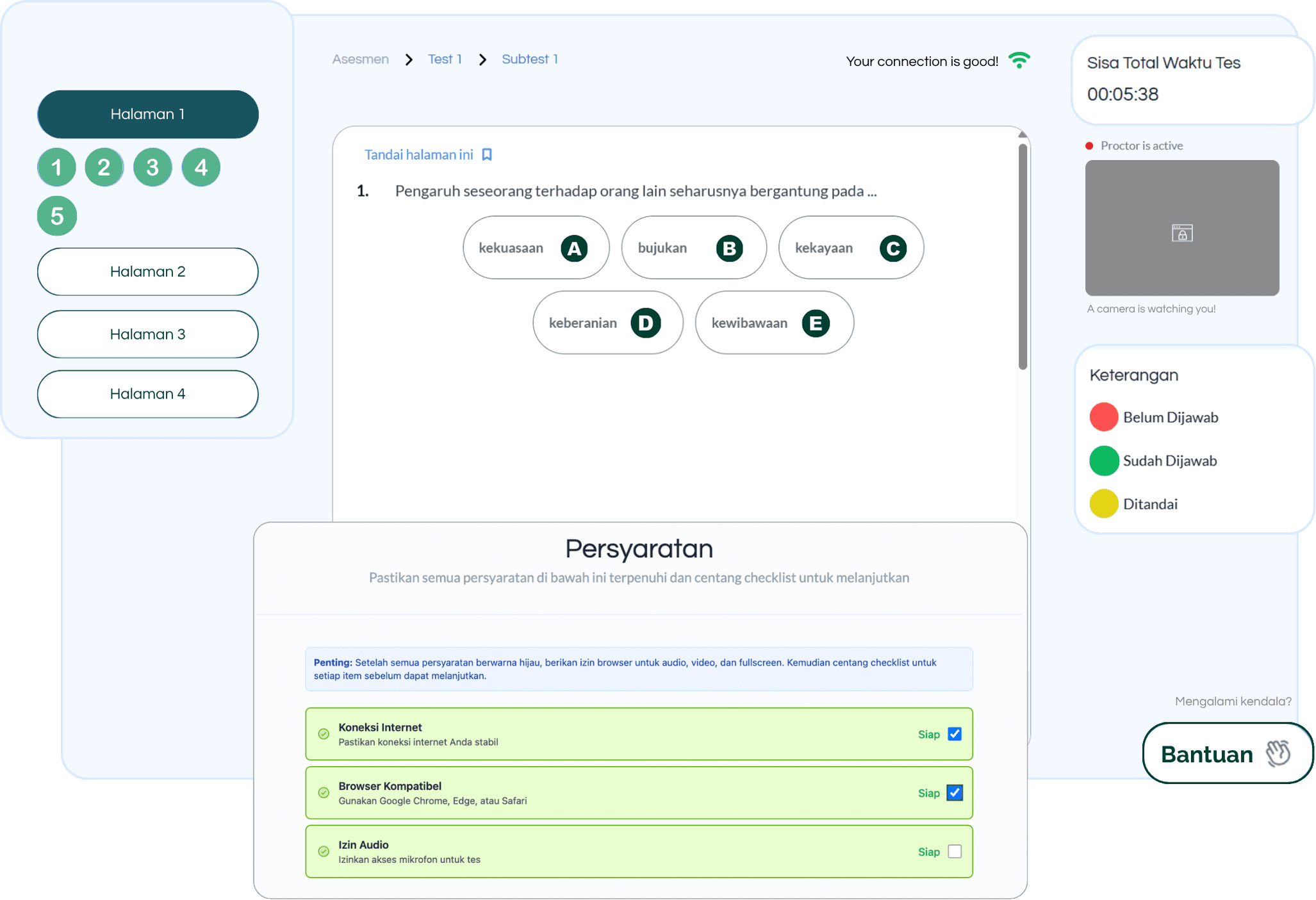
Students move through a consistent journey from invitation and guidance to the assessment itself, without switching between multiple apps.
Monitoring adds context rather than guaranteeing that every form of misconduct can be prevented. Assessment results should not be the sole basis for an education decision.
Use suitable instruments to help identify patterns in interests, abilities, learning preferences, or support needs.
Run institution-defined tests and criteria, with results serving as one input for the authorized decision-making team.
Use objective questions, essays, audio, video, surveys, or other instruments configured for the workflow.
Results can be prepared for students, psychologists, counselors, school leaders, or parents without remapping the process from the beginning.
Student reports with the agreed structure, language, and visual identity within the defined scope.
Multi-student data for class, cohort, and follow-up analysis.
Searchable, filterable, and exportable results with partial visual customization.
Group-level findings for student-support meetings and program planning.
Special formats can be developed through technical configuration when appropriate and authorized.
Real delivery context helps teams assess not only what is available, but how the configuration and operation work in practice.
 Education · Polytechnic
Implementation Case Study
How ASTRAtech used Scalify to deliver psychometric mapping for around 400 students concurrently in one platform.
The total reflects participant volume, platform use, instruments, support level, and output format. Components and estimates are agreed before delivery.
Practical guidance for planning tools, workflows, outputs, and budgets with greater clarity.
A guide for education teams planning interest, aptitude, and student mapping assessments, from purpose and instruments to reports and counselling follow-up.
Read guideA practical checklist for evaluating assessment tools, participant flow, scoring, reports, security, support, and total project cost.
Read guideCompare individual PDF reports, psychograms, Excel recaps, HTML dashboards, and report decks based on their readers and decisions.
Read guideScalify can support interest and aptitude tests, student mapping, selection, exams, mock tests, surveys, and institution-owned tools. Instrument fit, workflow, and outputs need to be mapped against the purpose and participant group.
Yes, provided the institution has the appropriate right and basis to use them. Scalify supports digitization, configuration, delivery, and result preparation but does not take ownership of or license the instruments.
No. Results are one source of information. Education decisions should also consider student context, observations, conversations, other relevant data, and the judgment of authorized professionals.
No. Instrument selection should consider the construct, participant age, norms, language, intended use, and supporting evidence. Results should not be interpreted beyond those limits.
It depends on the instrument and purpose. Psychological instruments and their interpretation need to follow the relevant professional authority. Scalify provides delivery infrastructure rather than replacing psychologists or education teams.
Yes, depending on scope. Results can be prepared as individual reports, multi-student recaps, dashboards, or group summaries with detail appropriate to each reader's role and purpose.
Pricing is based on usage volume, instruments, support level, and required outputs. There is no monthly subscription; the Pricing page explains each component, and the final estimate is agreed before delivery.
We will help map the instruments, class or batch flow, delivery, and result formats that make sense for your institution.