Conference abstract · 2026
Global Trends in Cognitive Measurement: A Bibliometric Analysis
A review of the cognitive measurement field by Anvesana researchers, not an IKN Umum validation study.
Read the research source (opens a new tab)Cognitive · Anvesana Research Institute
Maps cognitive ability through a choice of eight subtests, from reasoning and memory to numerical skills.
Specifications follow the developer's 2026 manuals. Appropriate norms, version, and use are discussed before delivery.
Sample with simulated data
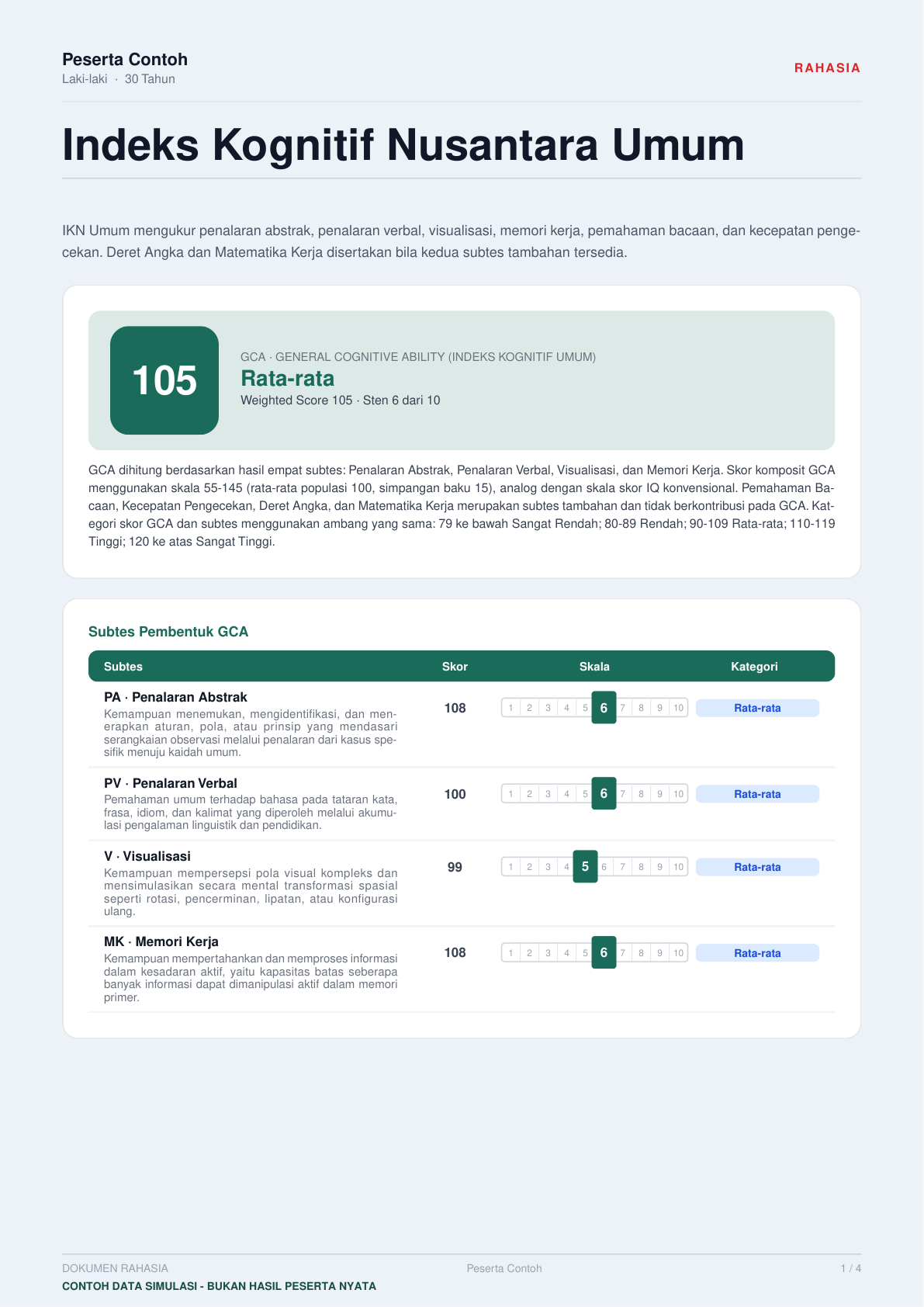
This Indeks Kognitif Nusantara sample report uses simulated data, not real participant results.
GCA is formed from four subtests. Detailed Number Series and Work Mathematics interpretations are not included in this sample.
Reports and sample questions are shown in Indonesian, the assessment language.
Loading page...
Which abilities help a person make sense of unfamiliar information? IKN Umum maps cognitive ability within the CHC framework. Eight subtest options cover reasoning, visualization, memory, reading, code matching, and numerical skills. Their composition is selected for the assessment purpose.
CHC (Cattell-Horn-Carroll Theory)
A cognitive profile is not a measure of a person's overall worth. Interpret scores alongside education, testing conditions, and other information. The manual's age range does not imply equally strong normative evidence for every age group.
These introductory examples use practice-guide material, not an operational item bank. Some diagrams and choices are adapted. Examples are shown in Indonesian, the language used in the assessments. No assessment scores are produced, and your choices are not sent or stored as test results.
Adapted practice example
1. Penalaran Abstrak (PAB)
The technical manual reports testing with 1,554 participants, including internal consistency and factor structure. Review that evidence for the population and decision involved. The public paper below concerns cognitive measurement research, not direct validation of IKN.
Distinguish instrument evidence, response-design research, and theoretical foundations before using results for decisions.
Conference abstract · 2026
A review of the cognitive measurement field by Anvesana researchers, not an IKN Umum validation study.
Read the research source (opens a new tab)Summary sources: Technical Manual Indeks Kognitif Nusantara Umum (2026), hlm. 2-9, 15-21
Reviewed 27 October 2026
Scalify clients can request the complete technical manual. Request the technical manual (opens a new tab)
Developed by
Scalify helps prepare participant access, delivery, scoring, and outputs within an agreed scope. Instrument selection and interpretation remain subject to professional competence and assessment requirements.