Work Aptitude · Anvesana Research Institute

Focusync

For HR and company teams: complement interviews with a picture of candidates' capacity, accuracy, and consistency during repetitive work.

Format and length
Three choices · repeated addition
Estimated duration
20-25 min
Age range
16-65 years
Category in the manual
C

Specifications follow the developer's 2026 manuals. Appropriate norms, version, and use are discussed before delivery.

Sample with simulated data

What do the results look like?

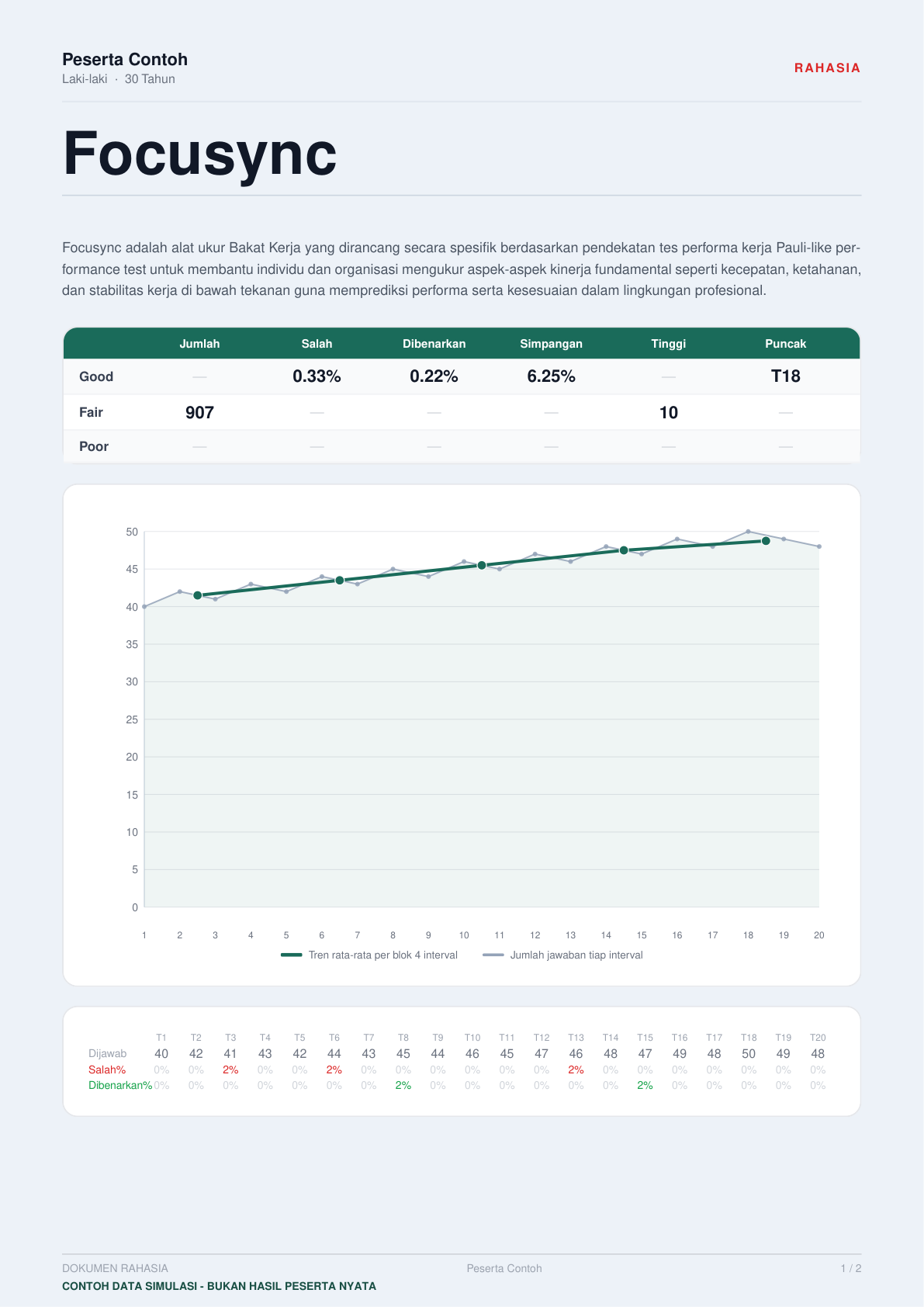
This Focusync sample report uses simulated data, not real participant results.

  • Response-volume curve across 20 intervals
  • Metric summary and work-pattern interpretation

Stability refers to work performance during the task. Results are not an emotional diagnosis or a guarantee of performance in a particular role.

Reports and sample questions are shown in Indonesian, the assessment language.

Enlarge (new tab)

Loading page...

Focusync sample report, page 1, simulated data

What does it help you understand?

Speed alone does not explain how someone works. Focusync observes work volume, accuracy, corrections, and changes in performance during a timed, repetitive task.

Measurement coverage

Pauli-type performance test, three-option format (trichotomous)

Work capacity
Volume of work completed during the test.
Accuracy
Precision of responses to the task.
Work stability
Consistency of performance, not emotional stability.
Peak productivity
Highest level of performance during the task.
Ambition and planning
Effort patterns interpreted through the work curve.
Corrections
Patterns of answer correction during the task.

Contexts of use

  • Complementing recruitment assessment with information about work capacity and accuracy.
  • Discussing work patterns during potential reviews and employee development.
  • Mapping routine-task performance, interpreted by a psychologist for the intended context.

Interpreting results

A work curve is not an emotional diagnosis or a guarantee of real-job performance. Combine results with other assessments, interviews, and role requirements. The relationship between efficiency scores and employee performance is still being researched.

What do the questions look like?

These introductory examples use practice-guide material, not an operational item bank. Some diagrams and choices are adapted. Examples are shown in Indonesian, the language used in the assessments. No assessment scores are produced, and your choices are not sent or stored as test results.

Tiga deret, tiga pilihan satu digit

Jumlahkan dua angka, lalu pilih digit satuannya. Dua deret pertama mengikuti contoh pada panduan latihan; deret ketiga melengkapi pengenalan pola yang sama. Contoh ini tidak memakai batas waktu dan tidak menghasilkan skor bakat kerja.

016 + 4·
Jawaban deret 1
023 + 6·
036 + 7·

Evidence and references

The 2026 technical manual reports testing with 2,653 participants. A separate public study compares two- and three-option response formats. These address different research questions: response-design findings do not automatically establish every interpretation of the test.

Distinguish instrument evidence, response-design research, and theoretical foundations before using results for decisions.

ICAP-H proceedings · 2025

A comparative analysis of 2-option and 3-option response formats for computerized work aptitude test

Research on Focusync response design. Consider its sample and limitations before generalizing to wider test use.

Read the research source (opens a new tab)
Summary sources: Technical Manual Focusync (2026), hlm. 2-9

Reviewed 27 October 2026

Scalify clients can request the complete technical manual. Request the technical manual (opens a new tab)

Developed by

Anvesana Research Institute

Include it in your assessment workflow.

Scalify helps prepare participant access, delivery, scoring, and outputs within an agreed scope. Instrument selection and interpretation remain subject to professional competence and assessment requirements.