Learning Style · Anvesana Research Institute

Inventori Gaya Belajar Indonesia

Maps preferences for experiencing, observing, conceptualizing, and experimenting during learning.

Format and length
7-point scale · 28 items
Estimated duration
10-15 min
Age range
12-60 years
Category in the manual
B

Specifications follow the developer's 2026 manuals. Appropriate norms, version, and use are discussed before delivery.

Sample with simulated data

What do the results look like?

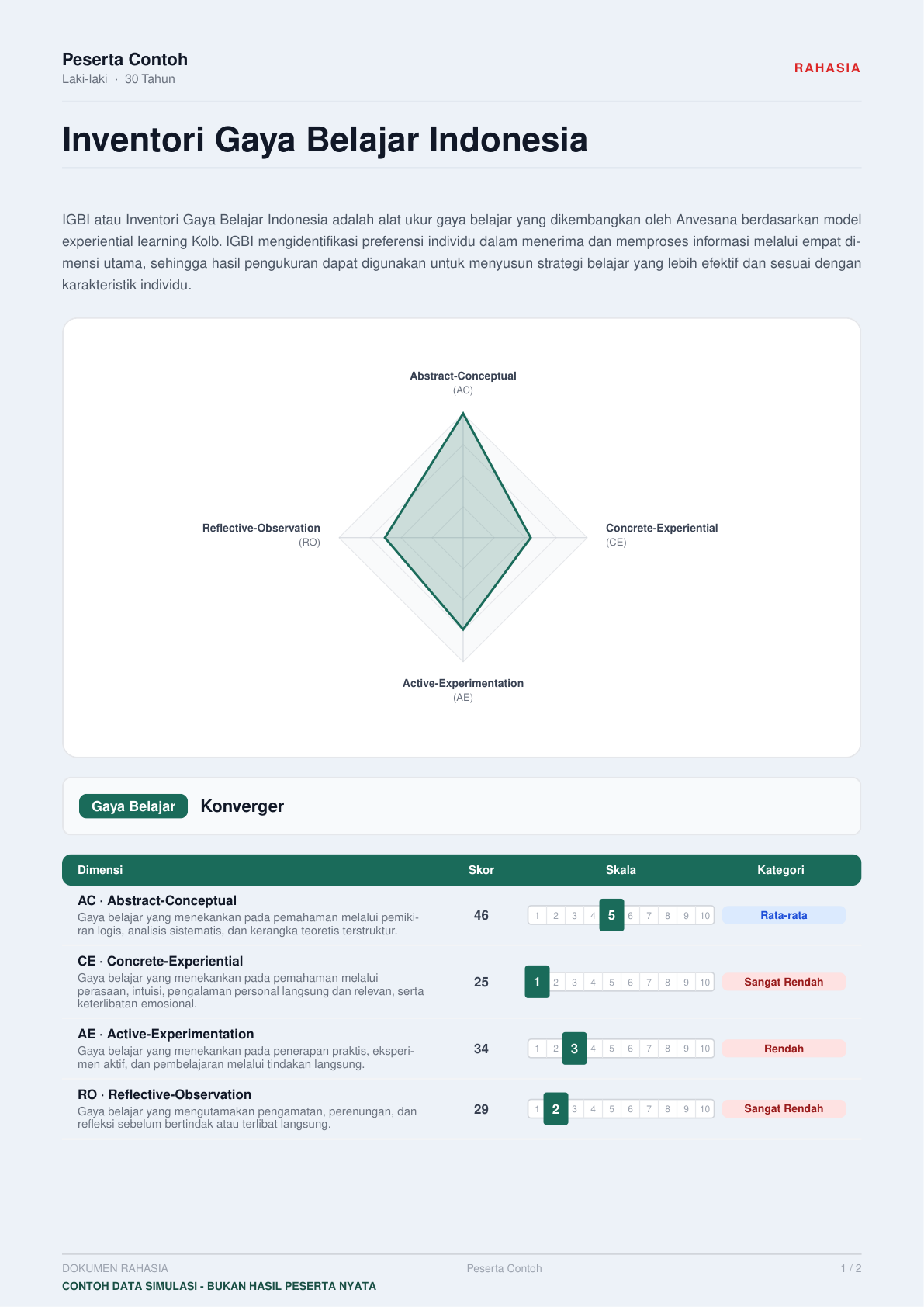
This Inventori Gaya Belajar Indonesia sample report uses simulated data, not real participant results.

  • Four learning-process preferences
  • A profile summary for reflecting on learning habits

Preferences are not ability levels or permanent labels. Results do not limit the ways a person can learn.

Reports and sample questions are shown in Indonesian, the assessment language.

Enlarge (new tab)

Loading page...

Inventori Gaya Belajar Indonesia sample report, page 1, simulated data

What does it help you understand?

Some learners prefer trying things, while others want to observe or understand concepts first. IGBI supports conversations about these preferences through four modes in Kolb's experiential learning theory.

Measurement coverage

Kolb's Experiential Learning Theory

Concrete Experience
Learning through feeling, intuition, and hands-on experience.
Reflective Observation
Learning through observation and reflection before acting.
Abstract Conceptualization
Learning through logical thinking and theoretical frameworks.
Active Experimentation
Learning through practical application and active experimentation.

Contexts of use

  • Reflecting on learning habits with students and counselors.
  • Discussing varied learning activities at school or university.
  • Exploring study strategies that still need to be tried and evaluated.

Interpreting results

A preference is neither an ability nor a permanent label. IGBI results do not establish that matching teaching to a single style improves achievement. Do not restrict learning opportunities based on the profile.

What do the questions look like?

These introductory examples use practice-guide material, not an operational item bank. Some diagrams and choices are adapted. Examples are shown in Indonesian, the language used in the assessments. No assessment scores are produced, and your choices are not sent or stored as test results.

Adapted practice example

Contoh pernyataan IGBI

Saya lebih mudah mengingat sesuatu jika saya melakukannya kembali.

1 = Sangat tidak sesuai · 7 = Sangat sesuai

Evidence and references

The manual reports testing with 305 high-school students, mainly from the Bandung area. Reflective Observation reliability remained below 0.70 in that study, so not all dimensions can be described as equally strong. The Kolb paper below is a theoretical reference, not IGBI validation.

Distinguish instrument evidence, response-design research, and theoretical foundations before using results for decisions.

Theoretical basis · Kolb & Kolb, 2005

Learning Styles and Learning Spaces: Enhancing Experiential Learning in Higher Education

Discusses experiential learning and learning environments, not IGBI psychometric testing.

Read the research source (opens a new tab)
Summary sources: Technical Manual Inventori Gaya Belajar Indonesia (2026), hlm. 2-6, 10-12

Reviewed 27 October 2026

Scalify clients can request the complete technical manual. Request the technical manual (opens a new tab)

Developed by

Anvesana Research Institute

Include it in your assessment workflow.

Scalify helps prepare participant access, delivery, scoring, and outputs within an agreed scope. Instrument selection and interpretation remain subject to professional competence and assessment requirements.